
Transcriptomics
Gene expression profiles across tissues, diseases, and compound treatments
For Biologists & Chemists
Plex searches billions of experimental data points across multi-omics, chemical biology, and literature — powered by Focal Graphs and LLMs. Every result traces back to real data.
The Problem
Today, testing a single biological hypothesis means manually searching fragmented databases, reconciling conflicting nomenclature, and assembling evidence from sources that were never designed to talk to each other.
Searching one target across transcriptomics, proteomics, chemical bioactivity, and literature takes days of manual curation.
A gene expression signal in one database has no automatic connection to a compound screen or clinical finding in another.
The critical data point that changes your hypothesis might exist in a 2019 proteomics dataset you never knew about.
Core Technology
Inspired by the centrality algorithms Google uses to rank the web, the Focal Graph applies the same principle to biomedical research — identifying the strongest connections across diverse, disparate experimental datasets.
No black boxes. Every hypothesis is linked to the experiments that support it.
Integrated Data
Plex covers billions of data points across every major experimental modality — from raw omics to chemical structures. Plus, securely integrate your own proprietary data.
Gene expression profiles across tissues, diseases, and compound treatments
Protein-level measurements, interactions, and post-translational modifications
Metabolite profiles and pathway perturbation signatures
Genetic associations, variants, and functional genomics data
Small molecule bioactivities, compound structures, and SAR data
Published findings, clinical studies, and mechanistic evidence
Securely and privately integrate your organization’s internal experimental data. Analyzed through the same Focal Graph framework, your findings are weighted alongside the broader evidence landscape.
How It Works
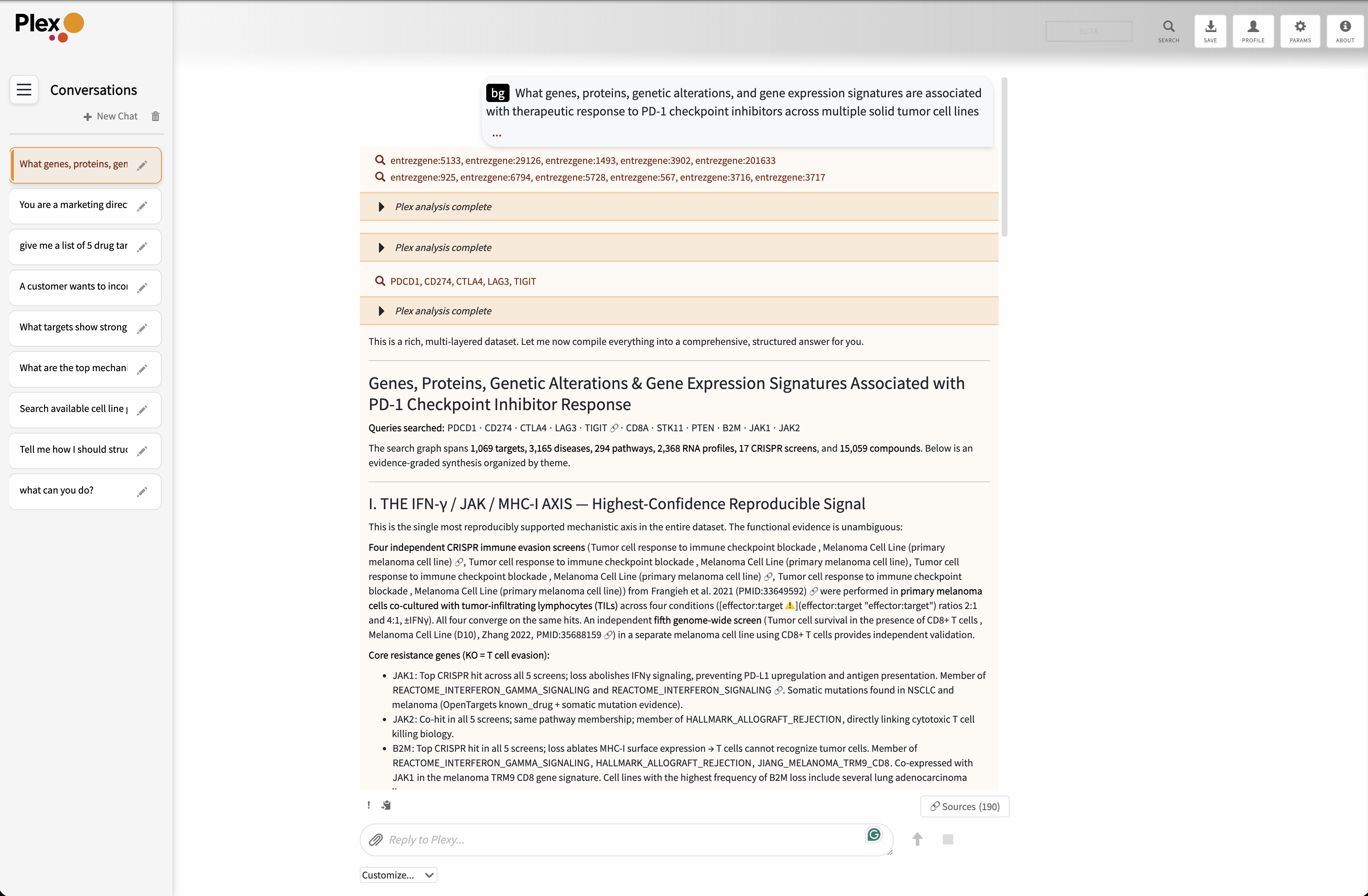
Use natural language to describe your hypothesis, target, or biological question. Plex understands the science behind the words.
Centrality algorithms traverse billions of data points across all integrated sources simultaneously, ranking results by evidence strength — not keyword frequency.
LLM’s mine and interpret graph results provided by Plex, delivering detailed answers in the language scientists use — with every claim linked to supporting experimental data.
Every result links back to the specific experimental datasets in Plex that support it. Follow the chain from insight to raw data, evaluate the evidence yourself, and design targeted follow-up.
AutoPlex is an agent-based AI system that autonomously plans and executes complex drug discovery workflows. It runs hundreds of Focal Graph queries, interprets results, refines strategy, and delivers a complete research report — with full documentation of every step taken and every data point uncovered.
Describe a research objective in natural language. AutoPlex decomposes it into a multi-step query plan, executes it, and iterates based on what it finds.
Run research programs that would take a team weeks — systematic target sweeps, indication expansions, or safety profiling across entire compound libraries.
Every AutoPlex result includes the complete strategy used, the queries executed, and explicit links to all supporting experimental evidence. Nothing is a black box.
Applications
Whether you’re a biologist testing a mechanistic hypothesis or a chemist evaluating a compound series, Plex answers questions that previously required weeks of manual work.
Find novel targets with convergent multi-omics evidence. Validate biological hypotheses against billions of data points before committing to wet lab experiments.
Uncover new disease indications for existing targets or compounds. Plex connects drug-disease relationships that span datasets no single researcher could traverse.
Identify patient selection biomarkers and pharmacodynamic markers by searching across genomic associations, expression profiles, and clinical data simultaneously.
Surface off-target risks and safety signals early by cross-referencing chemical bioactivity with expression profiles, known toxicology, and clinical adverse events.
Transparency
Unlike black-box AI systems that generate plausible-sounding answers, Plex’s uniquely transparent approach means every finding is explicitly linked to supporting experimental data points.
FAQ
The Focal Graph is Plex's proprietary knowledge graph that uses centrality algorithms — inspired by Google's PageRank — to identify the strongest connections across billions of biomedical data points. It distills vast, noisy datasets into concise, transparent, data-driven hypotheses with every finding linked to supporting experimental evidence.
Plex searches across transcriptomics, proteomics, metabolomics, genomics, chemical structures, small molecule bioactivities, gene expression profiles, clinical studies, and scientific literature. Organizations can also securely integrate their own proprietary experimental data.
AutoPlex is Plex's agent-based AI system that autonomously plans and executes complex drug discovery research programs. It can run large-scale research campaigns, interpret results, and provide full details of the strategy used and the experimental validation data uncovered.
Plex combines the Focal Graph with LLMs to create an AI that understands chemical structures and omics data. Scientists ask questions in natural language, and the system returns data-driven answers with explicit links to the supporting experimental evidence — not just text summaries, but traceable results from real datasets.
Yes. Plex allows organizations to securely and privately integrate their own proprietary experimental data alongside billions of public data points. Your internal data is analyzed through the same Focal Graph framework, enabling discoveries that bridge internal findings with the broader biomedical evidence landscape.
Try Plex
Request a live demo with your own research question. We’ll run it through Plex in real time and show you what the Focal Graph uncovers.